
If you’re new to pickleball or just need a refresher, this quick summary will walk you through the essentials so you can hit the court with confidence! While these guidelines capture the spirit and structure of the game, always refer to the official USA Pickleball rules for any disputes or nuances—official regulations take precedence.
Basic Game Format
Pickleball can be played as singles (one player per side) or doubles (two players per side), with doubles being the most popular format. Regardless of the number of players, the same court size and rules apply, keeping the experience consistent for everyone.
Serve and Service Sequence
The serve is a key element in pickleball, with specific requirements to ensure fairness:
- The server’s arm must move in an upward arc during the serve.
- Contact with the ball must be below waist level, and the paddle head below the wrist.
- A “drop serve” is also allowed, where these conventional restrictions don’t apply.
- At least one foot must stay behind the baseline and inside the sidelines at the moment of serve.
- Serves must go diagonally into the opposite service court and only one serve attempt is permitted.
In doubles, both teammates get to serve (except at the very start, when only one partner serves). The first serve of each side-out always comes from the right-hand court. Players switch sides after scoring points and continue serving until a fault occurs. In singles, the server serves from the right when their score is even and from the left when it’s odd.
Scoring Rules
Traditionally, points are scored only by the serving team (side-out scoring), with games played to 11 points—victory requires at least a two-point margin. Tournament matches might go up to 15 or 21 points. Some formats use rally scoring, awarding a point after every rally, regardless of who is serving.
When serving in doubles, the player who started the game for each team will be on the right side when their score is even and the left when it’s odd.
Two-Bounce Rule
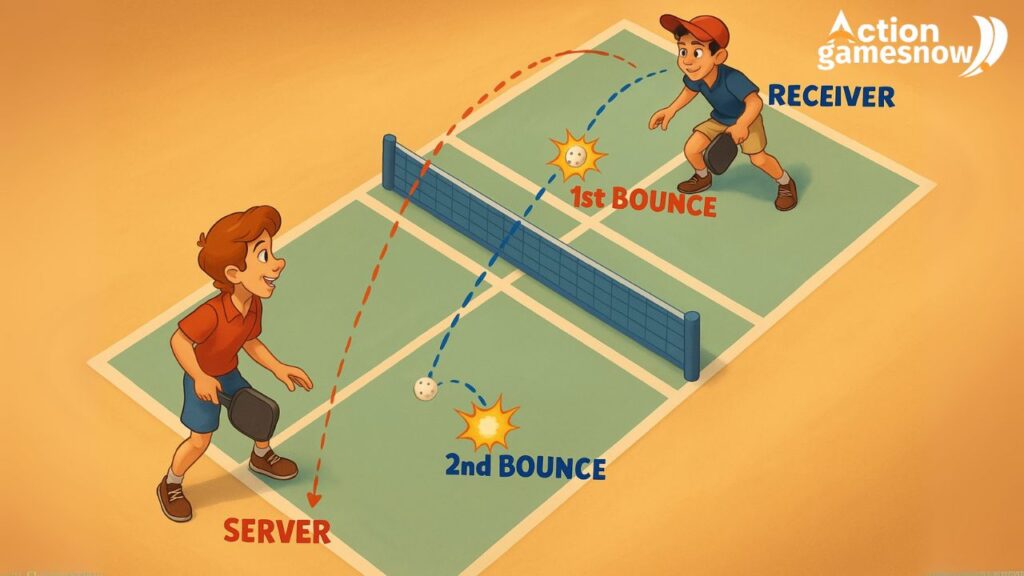
To keep rallies fun and fair, pickleball uses a “two-bounce rule”: when the ball is served, each team must let the ball bounce on their side before playing it. After these two bounces, anyone can volley or hit the ball off a bounce.
Non-Volley Zone (“The Kitchen”)
The non-volley zone—known as “the kitchen”—extends 7ft from the net on both sides. Players cannot volley while standing in this area or touching its boundary line. Any momentum carrying a player into the kitchen after a volley results in a fault, even if the ball is dead. You are free to enter the zone otherwise, but not while volleying.
Line Calls and Faults
Balls landing on any boundary line (except the non-volley zone line during a serve) are considered in. A serve touching the kitchen line is a fault.
Faults occur when:
- The serve lands outside the correct area
- The ball hits the net or is returned incorrectly
- The double-bounce rule isn’t respected
- Volleys happen from inside the kitchen
- The ball bounces twice before play
- Players, clothing, or paddle touch the net
- Service rules are violated
- The ball hits a player or something they carry/wear
- The ball hits a permanent object before bouncing
A fault committed by the serving team leads to loss of serve; by the receiver, it gives a point to the server.
Starting the Game
Any fair method (such as drawing numbers) can be used to decide which team serves or picks side first.
Pickleball’s rules are designed to create a fast-paced, fair, and enjoyable game for all skill levels. Keep these basics in mind, and you’re well on your way to great matches and lots of fun on the court!







Comments are closed.