
If you’re stepping onto the pickleball court for the first time, you might find yourself wondering about all those funny lines, rules, and paddle etiquette. Don’t worry—pickleball is easy to pick up, especially when you have a friendly guide to walk you through the basics.
In this post, you’ll find pickleball rules explained in a way that makes sense, feels fun, and helps you avoid those beginner mistakes everyone dreads.
Understanding Serve and Return Basics
Let’s start with one of the most important parts of pickleball:
The serve. You begin each point by serving underhand, which means you swing your paddle below your waist and hit the ball diagonally across the court. Your feet must stay behind the baseline when you serve, and you only get one try—no second chances!
The ball must clear the net and land in the opposite service court, and it can’t touch the kitchen (that’s pickleball slang for the non-volley zone).
When it comes to returning the serve, you want to let the ball bounce once on your side before you hit it back.
In fact, there’s a special rule just for this:
both the serve and the return must bounce before you can volley (hit it out of the air). This “double bounce” rule keeps rallies going and stops anyone from rushing the net too soon.
Once the ball has bounced on both sides, you’re free to volley—but watch out for the kitchen, because that area comes with its own set of rules.
Essential Scoring Rules Every Player Should Know
Scoring in pickleball might seem tricky at first, but once you get the hang of it, it’s actually pretty simple. Only the serving team can score points, so if you’re returning, your main goal is to get the serve back. Games are usually played to 11 points, and you have to win by at least two points—so 11-10 isn’t quite enough; you’d need 12-10 instead.
When you call the score, you’ll say three numbers:
your team’s score, your opponent’s score, and whether you’re the first or second server. For example, if your team has 5 points, the other team has 3, and you’re the first server, you’d call “5-3-1.” If you lose a rally while serving, your partner gets a chance to serve as the second server.
Only after both players lose their serve does the ball go to the other team. It might sound a little confusing, but after a few games, you’ll be calling out scores with confidence and maybe even a little swagger.
Tips for Staying Out of the Non-Volley Zone
The non-volley zone, also known as the kitchen, is a mysterious rectangle close to the net, and it has one big rule: don’t volley in the kitchen. A volley is when you hit the ball in the air before it bounces. If you step into the kitchen and volley, it’s a fault, and your opponents get the point.
You can step into the kitchen to hit a ball that’s bounced, but as soon as you volley, make sure your feet are behind the kitchen line.
One handy tip is to keep your toes pointed just behind the kitchen line when you’re at the net, so you can react quickly but not accidentally step over. It’s tempting to lean in for that perfect shot, but even if your paddle crosses the line, as long as your feet stay out, you’re safe.
Remember, balance is key in pickleball, both for your body and your strategy!
Common Faults and How to Avoid Them
Everyone makes mistakes, especially when they’re learning, but knowing the most common pickleball faults can help you avoid giving away easy points. One of the most frequent errors is serving the ball out of bounds or into the net—so take your time and aim for a smooth, controlled serve.
Another common fault is volleying in the kitchen, which we just talked about, so always check your feet before swinging at a high ball.
Double hits, where the ball touches your paddle twice, or carrying the ball (letting it rest on your paddle), are also faults, but these are pretty rare for most beginners. The best way to avoid faults is to play with focus and have fun. The more relaxed you are, the less likely you’ll make a rushed or nervous mistake.
Don’t forget to communicate with your partner, too! A simple “yours” or “mine” can stop confusion and keep rallies alive.
Wrapping Up
With pickleball rules explained and some practical tips under your belt, you’re ready to hit the court with confidence and a big smile. The more you play, the more these basics will feel like second nature, and you’ll start to develop your own style and strategy.
Don’t be afraid to ask questions, laugh at your own mistakes, and celebrate your improvements—pickleball is, after all, about having a great time with friends old and new.
Happy playing!
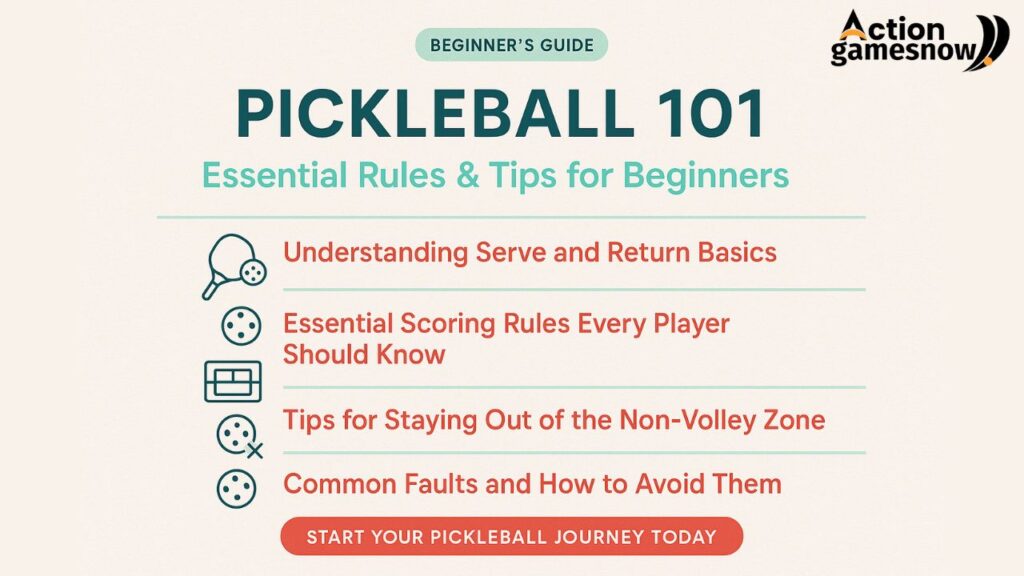
Here’s a chart table summarizing the key beginner pickleball rules and tips from your detailed post:
| Section | Key Points |
|---|---|
| Understanding Serve and Return Basics | – Serve underhand, below the waist, diagonally across court. – Only one serve attempt allowed. – Ball must land in the correct service court, not in the kitchen. – Serve and return must both bounce (double bounce rule) before open volley play begins. |
| Essential Scoring Rules Every Player Should Know | – Only the serving team can score. – Games typically to 11 points, win by two. – Score announced as: your score – opponent’s score – server number. – Each player on a team serves until a fault; then the other team gets the serve. |
| Tips for Staying Out of the Non-Volley Zone | – No volleying (hitting without a bounce) in the kitchen. – Feet must stay out of the kitchen when volleying. – It’s safe to be in the kitchen only if the ball has bounced. – Stand with toes just behind the kitchen line for quick net reactions. |
| Common Faults and How to Avoid Them | – Serving out of bounds or into the net is a common beginner fault. – Volleying in the kitchen leads to faults. – Double hits and carrying are faults but less common. – Stay relaxed, communicate with your partner, and focus to avoid easy mistakes. |





Comments are closed.