
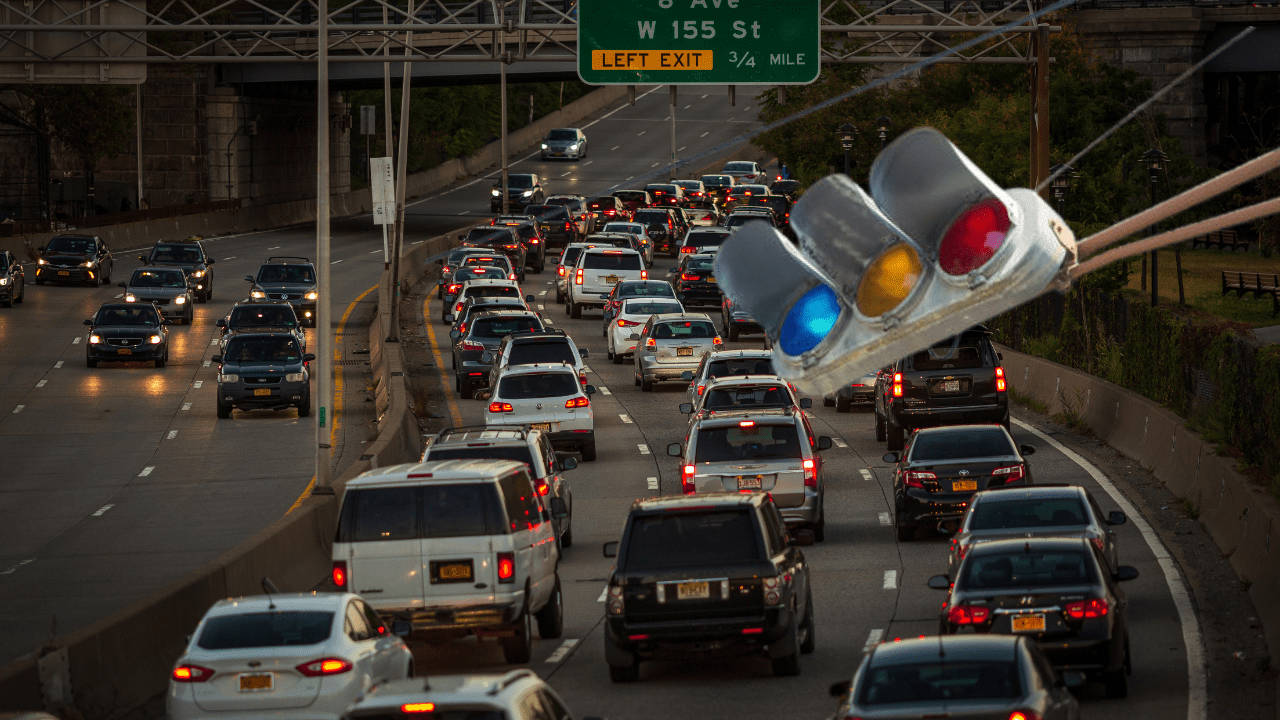
Most of us learn that red means stop and green means go long before we can see over the dashboard. Easy enough. But what happens when green also means blue in your culture? (Before we answer, here’s why our traffic lights are red, yellow, and green.)
When that happens, things like this happen. If you drive around Japan for a long time, you might see one of the country’s legendary blue traffic lights. Other places on the island have “go” signs that are definitely teal, turquoise, or aqua. You might ask, “Is this signal broken?” “Did a busy light installer put in the wrong bulbs?”
Atlas Obscura says that the answer is not in the wiring. It is written in the language of Japan.
Back a few hundred years, the Japanese language only had words for black, white, red, and blue. If you wanted to talk about something green, you would say “ao,” which is the word for blue.
This system worked fine until about the end of the first millennium, when the word “midori,” which originally meant “sprout,” started showing up in writing to mean “green.”
Even back then, people thought of midori as a shade of ao. As you might expect, this sudden change had long-lasting effects on Japan. One of the most common ways to play with words in Japanese is to write numbers instead of words or letters that have the same sound.
Even now, you can still find green things that are wrongly called blue. A fruit seller might try to sell you a “blue apple” (ao-ringo) that is actually green. In the same way, green bamboo is called aodake, which means “blue bamboo,” and a new worker who is “green” in America may be called a “aonisai,” which means “blue two-year-old.”
Now we’re ready to talk about traffic lights.
At first, all the traffic lights in Japan were green. Even so, official traffic documents in the country still called green traffic lights ao instead of midori.
International traffic law says that all “go” signals must be green lights, but Japanese linguists were upset that their government kept using the word “ao” for what was clearly “midori.” The government chose to find a middle ground.
“In 1973, the government ordered that traffic lights use the bluest shade of green possible. The lights are still technically green, but they are noticeable enough that the ao name is still appropriate,” writes Allan Richarz for Atlas Obscura.
So, it may look like Japan’s traffic lights are blue, but the government says they are actually just a very blue shade of green. They are green enough to meet international standards, but still blue enough to be called ao. Don’t say that bureaucracy has never solved a problem.
- NFL Week 2 Schedule 2026: Full Matchups, Kickoff Times & TV Channels

- World Cup 2026 Final Match Highlights: Spain’s Historic Triumph Over Argentina

- Spain’s 2026 World Cup Win: How They Did It

- FIFA 2026 Schedule Guide: Biggest Match, Date & Stadium

- Why USMNT Became America’s Soccer Identity?

- Donald Trump wants to make changes to Social Security cards

- Breaking: US State Department Issues Global Travel Alert – What Travelers Need to Know

- The Armchair Generals and the Quiet Privilege of Power

- Unexploded US Kamikaze Drone Found in Western Iraq Amid Rising Middle East Tensions

- The Moody-Intertek-Epstein Link: Untangling a Modern Corporate Mystery

- Rory McIlroy pays a touching tribute to his family after getting BBC Sports Personality of the Year: They’re my rock’

- Rory McIlroy gets into a banana peel problem after an off-target drive at the Australian Open








Comments are closed.