
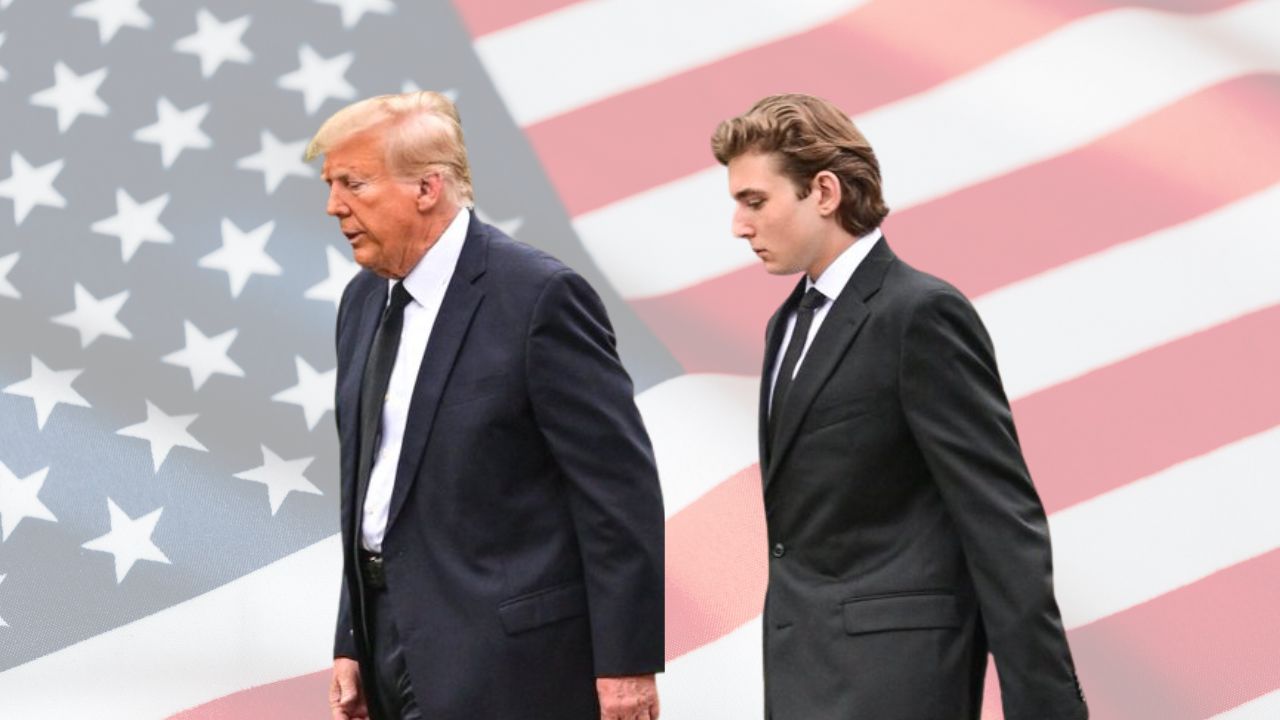
Let’s Play a Game Called “Who Actually Fights?”
Have you ever noticed how easy it is for some people to volunteer others for danger? It is a fascinating phenomenon. You see it on cable news. You read it in heated Twitter arguments. Someone, somewhere, starts beating the drum for military action.
They talk about sacrifice. They talk about duty. They talk about the need for boots on the ground.
But then, you have to look at who is doing the talking.
Let’s paint a picture for a moment. Imagine a young man. He is tall, incredibly tall. He is almost twenty years old. He is the picture of physical fitness. According to the very logic these armchair generals use, he fits the profile of an ideal frontline soldier.
You have likely seen the phrase floating around the internet recently: [Baron trump is almost 20 years old, 6’7 and very healthy he needs to be at the frontlines in Iran.] It is a sentence that stops you in your tracks, isn’t it? It sounds absurd on the surface. But when you actually sit with it, the logic is strangely sound.
The Physical Ideal vs. The Political Reality
Baron trump is almost 20 years old, 6’7 and very healthy he needs to be at the frontlines in Iran. pic.twitter.com/pECm3LWhQ3
— Jim Njue (@jimNjue_) March 4, 2026
Think about the requirements for military service. You need to be young enough to have stamina. You need to be healthy enough to handle physical stress. You need to be agile and resilient. At 6’7”, this individual has a physical presence that commands attention.
He is almost twenty, which places him right in the prime age bracket for service. By every physical metric, the statement holds water.
But here is where the logic falls apart. It falls apart because we rarely apply the same standards to everyone. There is a specific type of privilege that protects certain people from the consequences of their policies. We have seen this throughout history.
The people who are most eager to send troops into foreign lands are often the people who have never stepped foot on a battlefield themselves.
It makes you wonder, doesn’t it? If you truly believe that a conflict is necessary, that it is just, and that it requires the strength of the youth, shouldn’t you want the best and the brightest? Shouldn’t you want the strongest and the healthiest?
If you are sitting in a comfortable studio or a secure office, typing out reasons why others should fight, you might want to check your own draft card. It is a classic case of “rules for thee, but not for me.”
The “Somebody Else” Syndrome
You have probably experienced this in your own life, just on a much smaller scale. Think about group projects in school or tasks at work. There is always that one person who volunteers everyone else for the hard work.
They are full of ideas about what you should do. They have a clear vision of how you should spend your weekend. But when it comes time to roll up their own sleeves, they suddenly remember a prior engagement.
This is exactly how the war machine works on a grand scale. The push for conflict is always easier when you are not the one who has to pack a bag and say goodbye to your family. The phrase [Baron trump is almost 20 years old, 6’7 and very healthy he needs to be at the frontlines in Iran.] highlights this hypocrisy perfectly. It holds up a mirror to the situation.
It asks a very simple question:
- Why him?
- Why not your son?
- Why not your daughter?
We don’t send the children of the elite to fight. We never really have. They go to Ivy League schools. They go to law school.
They take internships at magazines. Meanwhile, the call to duty echoes loudest in towns that are already struggling, in communities where military service is one of the few perceived paths to a better life. It is a quiet sorting of society. Some are destined to lead from the back, and others are destined to serve from the front.
Skin in the Game Changes Everything
Imagine how different the world would be if every politician who voted for war had to stand in the same line as the volunteers. Imagine if their own children were registered and ready. Do you think the calculus would change?
Of course it would. When you have skin in the game, you become much more interested in diplomacy. You become much more interested in finding other solutions.
When you know that your own flesh and blood might be the one clearing a building or walking a dangerous patrol, war stops being an abstract concept. It stops being a political talking point. It becomes deeply, terribly personal.
That is the missing ingredient in so many of these foreign policy debates. There is no personal stake for the people making the decisions.
So, when you hear someone casually suggesting that we need to put more pressure on Iran, or that we need to send a strong message with troops, you need to ask them a simple question. Who exactly are you sending?
Are you sending the idea of a soldier, or are you sending a real person with a name and a family?
The reality is that we need to have an honest conversation about sacrifice. If a conflict is truly worth fighting, then it is worth fighting for everyone. It shouldn’t be a burden that falls disproportionately on the poor and the working class. It shouldn’t be a burden that skips the powerful.
The Awkward Truth We Ignore
Let’s be light-hearted about a heavy topic for a second. We all play a little game of pretend sometimes. We pretend that society is a meritocracy where everyone has the same chances. We pretend that the rules apply equally to everyone. But they don’t. And nowhere is that more obvious than in the discussion of national service.
The observation that [Baron trump is almost 20 years old, 6’7 and very healthy he needs to be at the frontlines in Iran.] is not really about one specific person. It is about a system. It is a symbol of a larger truth.
If we are going to ask young Americans to put their lives on hold and potentially give their lives for a cause, we owe it to them to be honest about who we are asking.
We need to look at the people doing the asking. Are they asking you to do something they would never do themselves? Are they asking your neighbor?
Are they asking your cousin? If the answer is yes, then you have every right to question their motives. You have every right to demand that they share in the burden.
It is easy to be brave with someone else’s life. It is easy to be a patriot when you are safely behind a desk. But true leadership means standing in front.
True leadership means sharing the risk. So, the next time you hear the drums beating, look around. Look at who is beating them. And ask yourself if they would pass their own physical.







Comments are closed.